 Re-Energizing the World
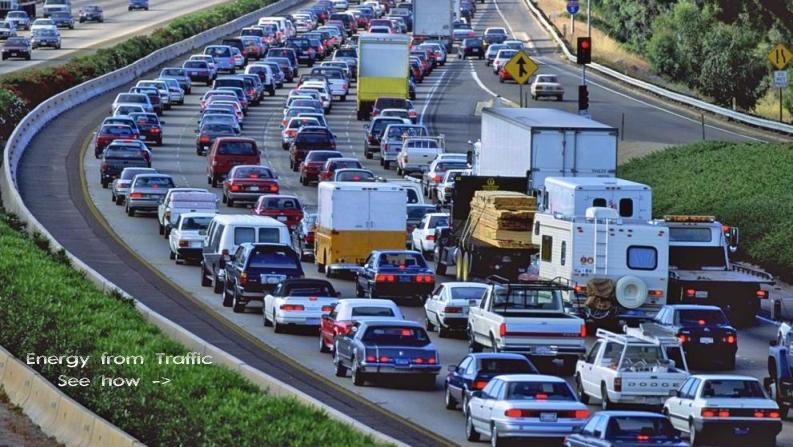
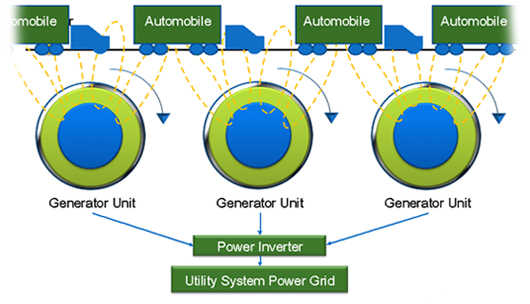
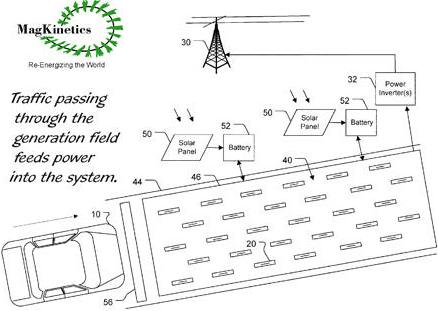
Generator units set beneath the road surface, turned by the magnetic pull of passing vehicles. No bumps, no change to the car, nothing burned.
How it works Read the patent applicationUntil now our use of cars and trucks has counted only as a cost in the energy equation. MagKinetics was founded to change that: to produce clean electricity from normal driving, without any change to the vehicle, our mobility or our freedom to drive.
The units belong where vehicles already slow down and energy is normally lost to braking: off-ramps, downhill slopes and approaches to traffic signals. The road surface stays smooth.
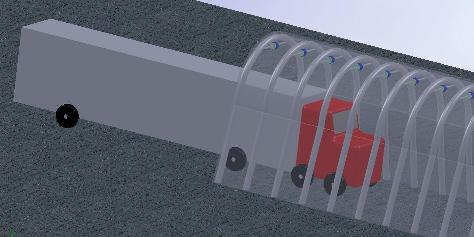
No. The system obeys the conservation of energy and the laws of thermodynamics. It captures energy from vehicles at points where that energy would otherwise be lost to braking.
At a slowing-down point, such as a signal or an exit ramp, the magnetic drag helps the vehicle slow down, adding braking force. It is placed where drivers are already braking.
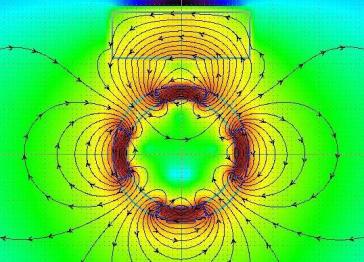
Inside a car, the body of the car acts as a shield against the field.
In 2008 the company set a goal of 2 megawatts in a quarter mile of road. That figure was a goal, not a measured result; measuring it is the job of the prototype.
"A system and method for generating electricity from the movement of vehicles over a traveling surface is provided. In one embodiment, the system includes a stator having a plurality of windings, a rotor configured to rotate and configured to be mounted adjacent the traveling surface, the rotor having a perimeter and a plurality of magnets mounted to the perimeter..." (from the published abstract)
Open the full application (PDF)| Inventor | Mark J. Nejmeh |
| Applicant | MagKinetics Inc. |
| U.S. application | No. 11/971,653, filed January 9, 2008 |
| International application | PCT/US2009/030423, filed January 8, 2009 |
| Published | WO 2009/089336 A1, July 16, 2009 |
| Status today | The international application did not enter national phases, so no patent issued from it. The published application stands as a public record of the invention and its date. |
| System and Method for Generating Electricity from Automobile Traffic MagKinetics Inc., applicant | U.S. application 11/971,653, filed January 9, 2008 · International application PCT/US2009/030423, filed January 8, 2009 · Published as WO 2009/089336 A1, July 16, 2009 · Google Patents · PDF |
| Disciplining Interaction Among Users of a Social Network A voice dating app: users first meet through voice recordings, and full profiles unlock only after enough real exchanges. Mark Joseph Nejmeh, applicant | Priority date March 3, 2017 · U.S. application 15/871,424, filed January 15, 2018 · Published as US 2018/0253801 A1, September 6, 2018 · Not granted · Google Patents · PDF |

Inventor of the MagKinetics technology. Built Continental Roof Systems into a public-works company in New Jersey; created AuctionQuest, one of the first online auctions, in 1990. B.A., Upsala College.
The engineers who worked on the prototype as interns. In Mark Nejmeh's words, they "were part of the team that proved it."
B.S. in electrical engineering, Purdue University; digital systems design.
Mechanical engineer, Purdue University; master's work in design, dynamics and vibration control.
B.S. in mechanical engineering with a minor in electrical engineering, Purdue University; graduate research in human motion kinetics.
S.B. in mechanical engineering, Massachusetts Institute of Technology, 2008; research in green building technology.
B.S. and M.S. in electric power engineering (superconducting applications in power systems); research at the University of Houston in magneto-optical and thermal imaging.
Officers of MagKinetics when the patent applications were filed. They are not part of the company today.
Ten years as a government and Wall Street banking analyst, then founded companies in international trade and U.S. distribution. Graduate degrees in economics, Georgetown University and the London School of Economics.
CPA and Fairleigh Dickinson University graduate; 30 years running industrial companies, including operations at Dominion Colour.
Domestic and international business development and strategic marketing. B.A. in business administration, Upsala College.
Mark Nejmeh intends to build a working prototype of the MagKinetics generator: a unit under a real road surface, with its output measured. He plans to apply for an updated patent on the improved design. Engineers, universities and road builders who want to take part are welcome to call.
Get in touchEvery filing date on this page comes from a public record you can open.